




REDESIGNING
RACE
FUEL
In a partnership driven by ambition and trust, world-leading engineers are working towards more sustainable fuel solutions for Formula 1
In 2024, 78.2% of Shell’s global investments included oil & gas, 11.37% included low-carbon energy solutions and 10.43% non-energy products. Shell’s target is to become a net-zero emissions (NZE) energy business by 2050. Disclaimers, including NZE target: shell.com/disclaimer
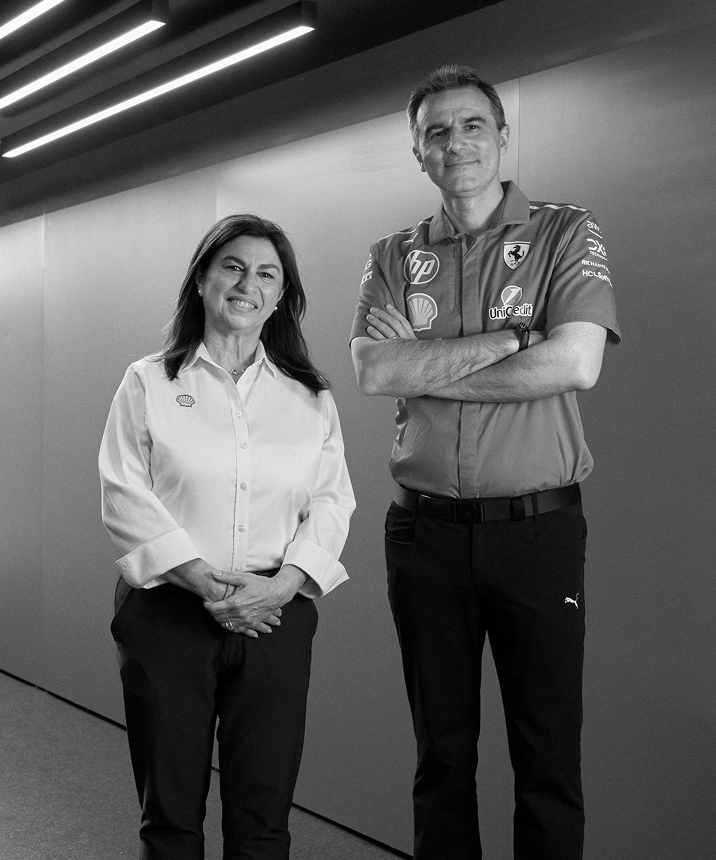
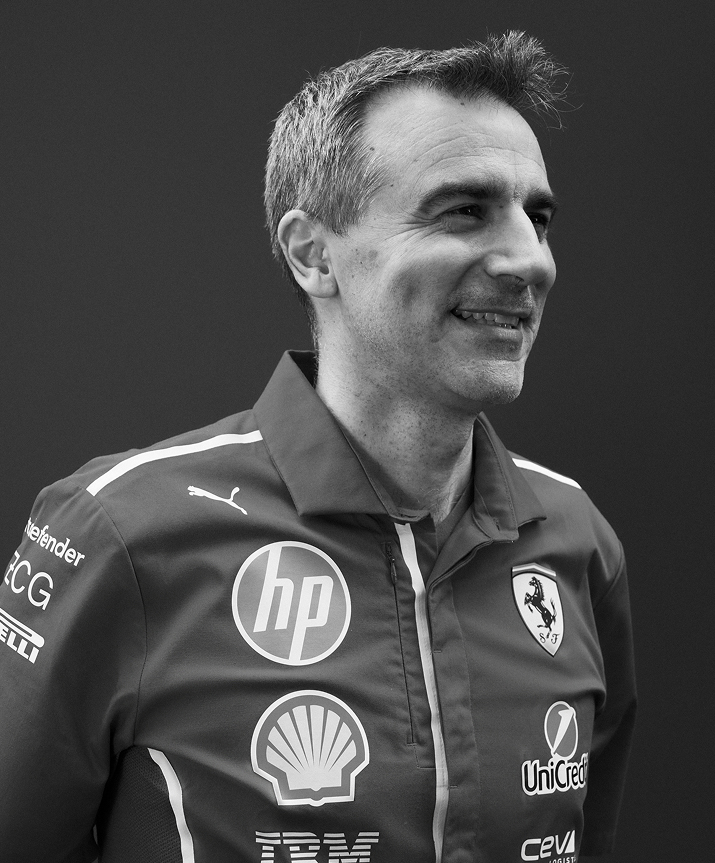
The 2026 season heralds a new era for Formula 1 where teams are required to use fuels incorporating components classified as sustainable by the sport’s governing body, such as agricultural waste. For a motorsport with origins firmly in the fossil fuel era, this marks a radical change and a transition that is a near-total focus for Enrico Gualtieri, Technical Director of the Power Unit for Scuderia Ferrari HP, which is the carmaker’s racing division.
“I’m from Modena, so Ferrari was part of my childhood,” says Gualtieri. “We felt part of celebrations or news. Yet it wasn’t something that I dreamt would be my career.” But when Gualtieri, now 50, came to study mechanical engineering at university, he specialised in the internal combustion engine.
“Everything somehow came together: my engineering passion and being close to Ferrari, where I was able to do my final thesis,” he says. “I was attracted to the Formula 1 challenge, of trying to get every detail right.”
Overseeing technological innovation, Gualtieri, who refers to himself as simply “an engine guy”, is a key player in the F1 team’s enduring collaboration with Shell. Ferrari and the energy giant have history, having first collaborated on fuel and lubricants for Formula 1 cars during the 1950s; the oil and gas company first greased Ferrari’s wheels to victory in the 1951 British Grand Prix. Throughout their partnership, Shell and Ferrari have won 10 constructors’ and 12 drivers’ championships, a record in Formula 1. Now, with the move to race fuel made from advanced sustainable components imminent, the partnership is being put to its greatest test.
“
I was attracted to the Formula 1 challenge, of trying to get every detail right
AN UNPRECEDENTED CHALLENGE
Gualtieri’s close collaborator is Selda Gunsel, Shell’s Chief Technology Officer. “Shell is fully supportive of Formula 1’s requirement of using race fuel made from advanced sustainable components,” says Gunsel, a Turkish-American based in Houston. “It’s an opportunity for us to push the boundaries of innovation.”
The F1 track appeals to Gunsel, a distinguished chemical engineer, as an arena for testing fuel at extremes. “I saw my first Formula 1 race 15 years ago: Lewis Hamilton winning the Canadian Grand Prix in Montreal. I was impressed that it was about performance through technology – and talent. It’s a full circle moment for me that Hamilton is now part of the Scuderia Ferrari HP team.”

From the 2026 F1 season, new fuels are derived in part from known sources, such as petrol alternatives based on plants. “The fuel we previously supplied for Scuderia Ferrari HP was made with 10 per cent second-generation bioethanol using sugar cane waste from a joint venture in Brazil,” reflects Gunsel. “Under the new regulations, we must use 20 per cent fully sustainable oxygenates, such as ethanol, in the fuel. But the rest – 80 per cent – has been invented.” She continues: “This work may contribute to pathways for reducing carbon emissions, calculated on a life-cycle basis, in motorsport and, potentially, road transport.”
IN STRICTEST CONFIDENCE
Ferrari and Shell are counting on Gunsel and Gualtieri’s long-standing partnership. Their shared task means the pair have marshalled their teams to collaborate at scale, sharing data with the industry where they can. “Formula 1 is a highly competitive environment,” says Gualtieri. “By nature, we guard our secrets. But we are open in sharing whatever is possible within the regulations – even our failure points, because it’s only in sharing this challenge that we can progress. Shell earnt our trust by embracing the challenge with us.”
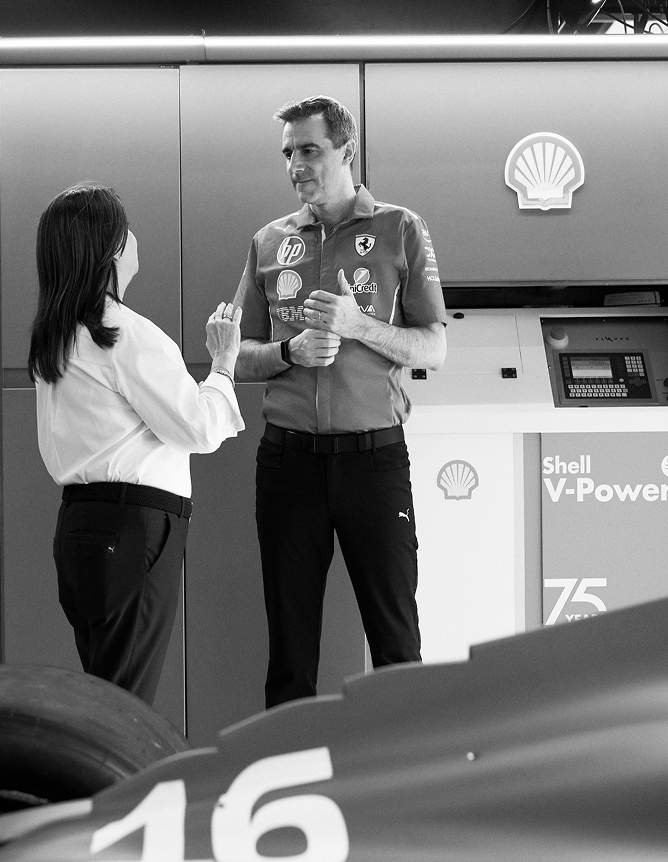
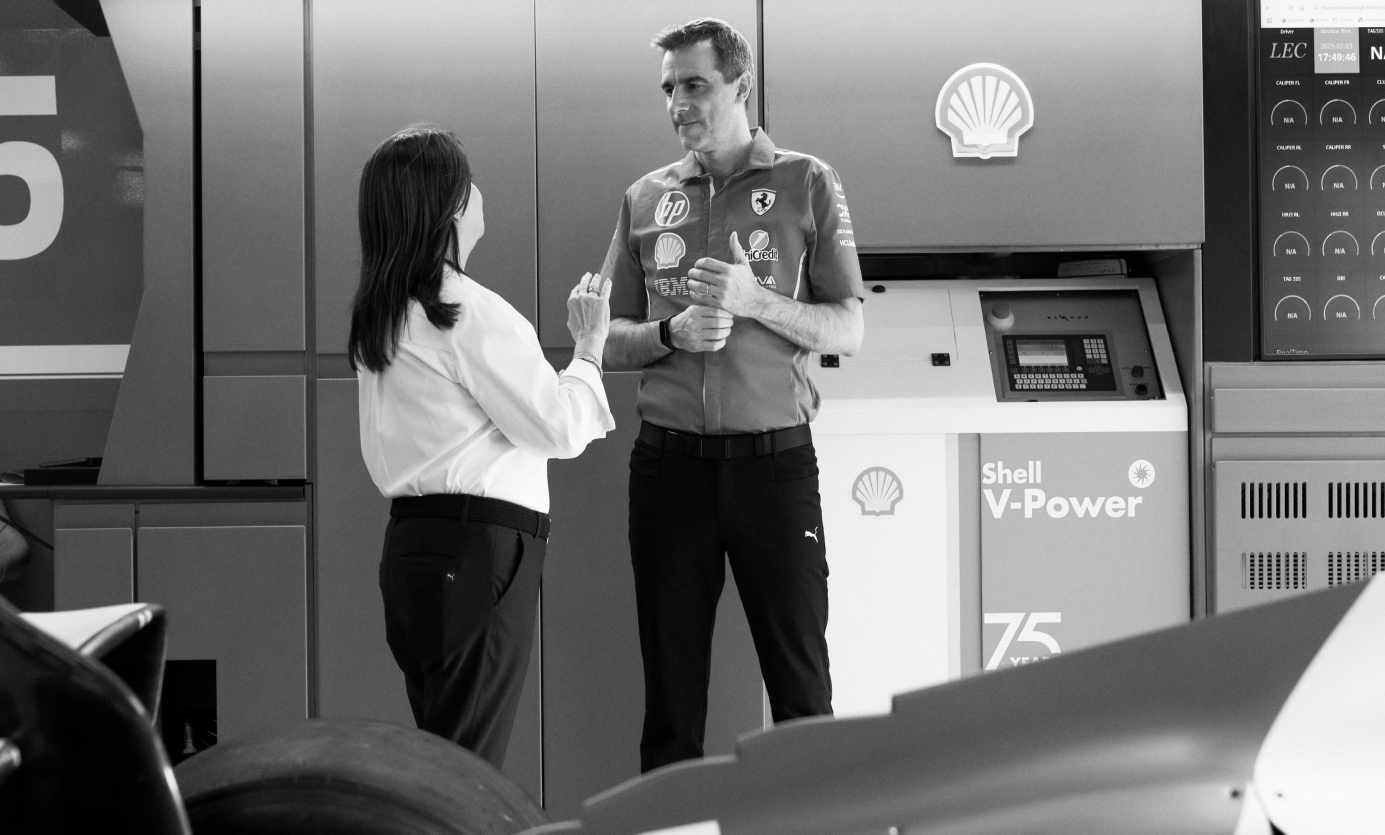
“Working together as one team is critical,” says Gunsel. “I have the chemical engineering background, Enrico the mechanical engineering – a perfect combination for the problems we need to solve.” Gualtieri nods. “You cannot innovate in isolation,” he says. “It’s a matter of having tough, respectful discussions among all partners. Our teams challenge each other daily.” This pooling of skills reaches beyond the two companies. “We work extensively with research partners,” says Gunsel. “Universities, research institutes and start-ups – because we have to develop new molecules and new process technologies.”
“
I have the chemical engineering background, Enrico the mechanical engineering – a perfect combination for the problems we need to solve
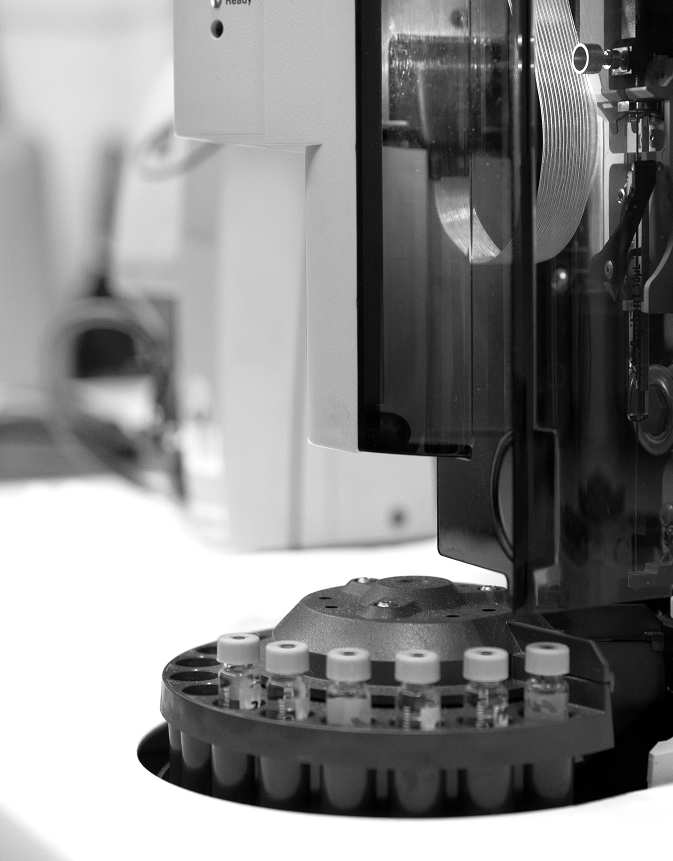
Unlike fossil fuel molecules, available to chemists on the mass market, sourcing the building blocks of fuels made from renewable feedstock has led into uncharted territory, and represents a supply chain challenge. “Many of the molecules we need for meeting FIA’s performance and sustainability requirements are ones that we had to invent,” says Gunsel. “Here, AI has played a role, helping create simulations that can predict combustion behaviour and the performance. To develop a single fuel that the Scuderia Ferrari HP team have been using in recent years, we did simulations of around one million formulation options.”
The success of the pioneering fuel that powers Scuderia Ferrari HP round the track during the 2026 Formula 1 season now hinges on how both teams apply these learnings, and requires ongoing trust in the collaboration. “The regulations require a way of producing what we know is needed for the engine, in a completely different way,” says Gualtieri. “So we are exploring new routes together. That is the only way we can achieve our goals.”
In 2024, 78.2% of Shell’s global investments included oil & gas, 11.37% included low-carbon energy solutions and 10.43% non-energy products. Shell’s target is to become a net-zero emissions (NZE) energy business by 2050. Disclaimers, including NZE target: shell.com/disclaimer
LEARN MORE ABOUT SHELL AND FERRARITHE ENDURANCE ENGINEERS
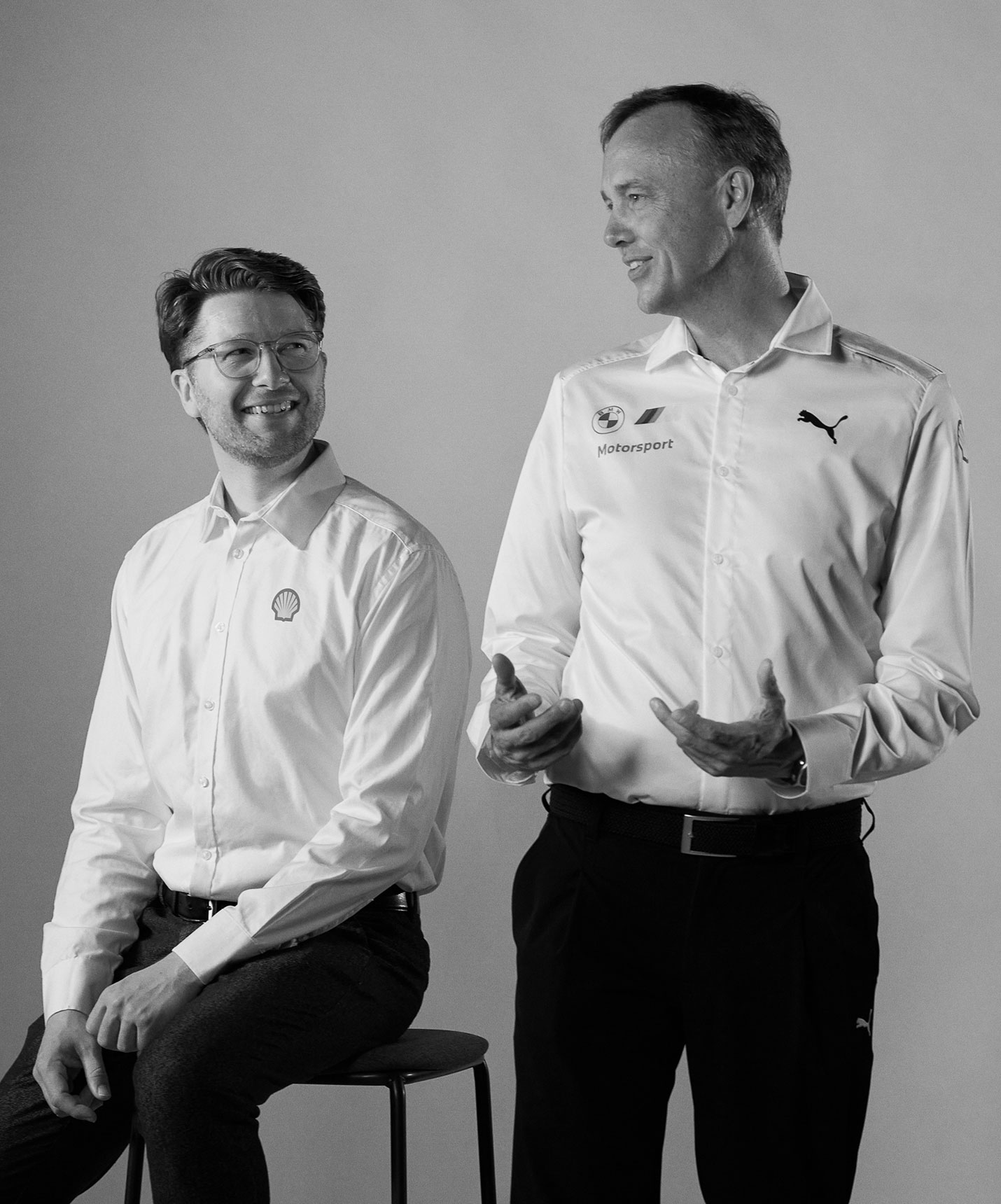
Races like Le Mans push motoring and lubricant performance to their limits, making them ideal testbeds for innovation
SHARED HORIZONS
Collaboration between an airline and its fuel supplier may help address some of the aviation industry’s challenges

FLUID THINKING
Collaborative research has led to the first certification by a major chipmaker for a cooling liquid that could help tackle data centre power demand